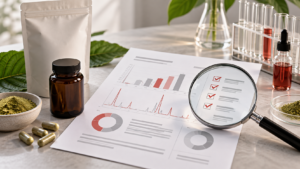
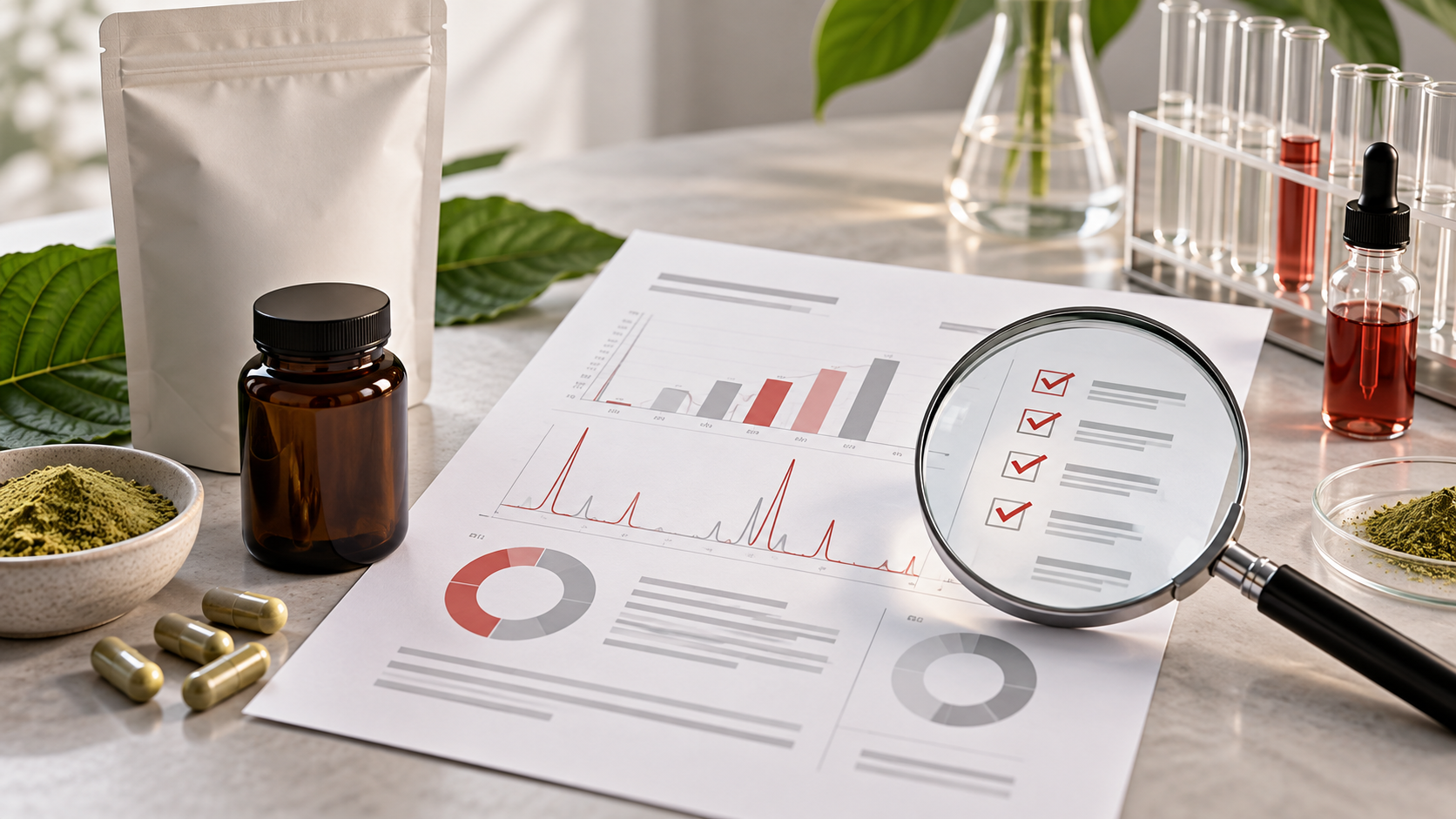
A certificate of analysis is the only document that shows what is actually in the bottle, and most people never read past the first line. Learning how to read a Certificate of Analysis (COA) takes about ten minutes and can tell you more about a product than any label, review, or marketing page.
The stakes are real. Herbal products are not pre-approved by regulators for purity or potency before they reach shelves. In the United States, dietary supplement makers are responsible for the quality of their own products, and that includes botanicals like kratom, cat’s claw, turmeric, and boswellia. A COA is how a responsible brand shows its work.
But a COA is also easy to fake, easy to misread, and easy to cherry-pick. A glossy PDF with a lab logo is not proof of anything until you know what to look for. This guide walks through five checks, in the order you should do them: the document header, alkaloid content, heavy metals, microbial testing, and lab accreditation. We will use a typical kratom lab result to show how each section works, then apply the same skills to herbal supplements for joint health, where the testing questions are different but the reading method is identical.
One note before we start: this article is educational. It is not medical advice, and reading a COA does not make any product safe for every person. It simply lets you buy with your eyes open.
What a COA Is?
A certificate of analysis is a report from a laboratory describing the results of tests run on a specific sample from a specific batch of product. It usually lists the test method, the result, and a limit or specification for each item, so you can see whether the batch passed.
That definition contains three ideas worth holding onto:
- Specific sample. The lab tested the sample it was sent, not necessarily every bottle in the batch.
- Specific batch. Results apply to one production run. A COA from January does not describe a product made in June.
- Pass or fail against a limit. A number without a limit is trivia. A number next to a clear limit is information.
Why COAs matter more for botanicals?
Plants are variable. Soil, climate, harvest timing, drying, and storage all change what ends up in a leaf or a bark. Two batches of the same herb can differ in active compounds, and plants absorb metals from the ground they grow in. Kratom trees, for example, grow in tropical soils that can be naturally high in certain metals, and processing can introduce microbes if drying and handling are careless.
What a COA cannot tell you?
A COA does not prove a product is effective, and it does not prove a product is safe for you. It also does not certify that a brand’s marketing claims are true. It answers a narrower question: did this batch contain what it should, and stay under the limits for contaminants it was tested for? That is still very valuable. It is simply not the whole story.
Two other cautions belong here. First, a COA only covers the tests listed. If a report shows potency but no contaminant testing, the missing sections are telling you something. Second, third-party COAs are better than in-house ones, for reasons we will cover in the accreditation section.
Step 1: Start With the Header
Before you look at a single result, confirm that the document is about the product in your hand. Many misleading COAs are technically accurate reports that simply belong to some other batch.
Check these items at the top of the page:
- Product name and type. Does it match your product, including form (powder, capsule, extract, tablet)?
- Batch or lot number. It should match the number printed on your package exactly. If a brand posts one generic COA for everything, that is a warning sign.
- Sample and report dates. Look at the manufacture date, test date, and report date. Testing should come after production and well before the product’s expiration.
- Laboratory name and contact details. A real lab lists a physical address, phone number, and often a report or sample ID you can reference.
- Client name. This shows who submitted the sample, the brand or someone else.
- Signature and approval. Legitimate reports carry the name of an authorized reviewer or a digital signature.
Try the batch number test
Many brands let you find COAs by entering a batch number or scanning a QR code on the package. Do it. Then compare the batch number on the PDF to the one on your package character by character. If they differ, the report is not about your product, whatever else it says.
Look for the sample description
Good reports describe how the sample arrived: its condition, weight, and whether the lab received it directly or through the brand. This matters because a lab can only vouch for what it received. A report that says the sample was “supplied by client” without details is weaker than one that documents chain of custody.
Step 2: Read the Alkaloid Panel
The alkaloid panel is the part of a kratom lab result that most people jump to first. It reports the concentration of the plant’s active compounds, and it is where the difference between a natural leaf product and a concentrated one shows up.
The two numbers to find
Kratom leaf contains dozens of alkaloids, but a standard panel focuses on two:
- Mitragynine, the most abundant alkaloid in the leaf. Results are typically shown as a percentage of the sample’s weight, or in milligrams per gram.
- 7-hydroxymitragynine (7-OH), which occurs naturally in trace amounts in leaf but is far more potent at opioid receptors than mitragynine.
Both compounds act on the body’s opioid receptors, which is why serious labs, clinicians, and regulators pay close attention to them. Clinical resources such as Labcorp’s provider guidance on kratom and 7-OH emphasize that the two compounds are distinct and that 7-OH is the one of particular concern at high concentrations.
What a natural leaf profile looks like?
In traditional leaf powder, mitragynine is the dominant alkaloid and 7-OH is a very small fraction, generally well under one percent of the total alkaloids. If a COA shows 7-OH at a level that looks high relative to mitragynine, that is a signal to slow down. It may indicate a concentrated or chemically altered product rather than a plain leaf.
This matters because in recent years products with concentrated or semi-synthetic 7-OH have entered the market, and U.S. regulators have moved to restrict them. A COA that reports 7-OH clearly, rather than omitting it, is a mark of transparency.
How to sanity-check the numbers
- Match units. Percent, mg/g, and mg/serving are not interchangeable. Convert them before comparing brands.
- Look for the method. Reputable labs name the technique, commonly HPLC or LC-MS/MS. Those are standard, well-accepted methods for alkaloid quantification.
- Check for a limit of quantitation. Often shown as LOQ, it is the lowest amount the method can measure reliably. A result of “ND” (not detected) or “<LOQ” means the compound was below that threshold.
- Be skeptical of round numbers and perfect results. Real plant material varies. A panel showing the exact same values across many batches deserves questions.
A note on interpretation: a high alkaloid percentage is not a quality score. Higher is not better, and a COA is not a recommendation about how much of anything to use. It simply tells you what is in the sample.
The same idea applies to other botanicals
For a product like cat’s claw, the equivalent measurement might be total oxindole alkaloids. For turmeric, it is curcuminoids. For boswellia, it is boswellic acids. Whatever the plant, the potency section should name the marker compound, state the amount, and identify the method.
Step 3: Check Heavy Metals
If alkaloids tell you about potency, the heavy metals panel tells you about purity. It is often the most overlooked section of a COA, and for a plant grown in soil, it may be the most important.
Why are kratom heavy metals a live issue?
The conversation around kratom heavy metals is not hypothetical. The U.S. FDA has published laboratory analyses of kratom products for heavy metals, and its findings raised concern about certain metals, particularly lead and nickel, in some of the products it tested.
The agency noted that long-term, regular exposure at those levels could pose a health risk. Because these results came from testing actual retail products, they are a useful reminder that a plant product being “natural” says nothing about whether it is clean.
The reason is simple. Plants draw up minerals and metals from the soil and water where they grow. Metals can also enter through processing equipment, drying surfaces, and packaging.
The four metals to look for
Most standard herbal panels test the “big four,” and some labs add more:
| Metal | Why it is tested |
|---|---|
| Lead (Pb) | Accumulates in the body over time; especially concerning for children and pregnancy |
| Arsenic (As) | Naturally present in some soils; long-term exposure is linked to serious health effects |
| Cadmium (Cd) | Can build up in the kidneys with chronic exposure |
| Mercury (Hg) | A neurotoxin; more often a concern with certain sources and processing |
Some labs also report nickel, chromium, or copper. If a brand tests for nickel on kratom specifically, that is a good sign, given the concerns raised in public analyses.
How to read the results?
A heavy metals table typically has four columns: the metal, the result, the unit, and the limit. Units are usually parts per million (ppm), parts per billion (ppb), or micrograms per gram (mcg/g). Watch the units carefully, since 1 ppm equals 1,000 ppb.
- Compare result to limit: The result should sit clearly below the stated limit.
- Find out where the limit comes from: Labs commonly reference limits from bodies such as the United States Pharmacopeia (USP), state programs like California’s Proposition 65, or other published standards. The COA should say which standard it uses. Limits differ from one standard to another, so “passed” only means something if you know the bar.
- Read “ND” and “<LOQ” correctly: Not detected means below what the method can measure. That is good, but it depends on how sensitive the method was.
- Watch for a missing panel: A COA that covers alkaloids and nothing else has left out one of the most important safety checks.
The analytical method
The standard technique for trace metals is ICP-MS (inductively coupled plasma mass spectrometry), which can detect very low concentrations. If the report names ICP-MS or a comparable validated method, that is reassuring. If it names no method at all, ask why.
Step 4: Confirm Microbial Testing
Microbial testing checks whether a product carries living contaminants, such as bacteria, yeast, and mold. For a dried plant material that is ground, stored, and shipped, this is a fundamental safety check.
Why it matters?
Botanicals are agricultural products, and agricultural products meet microbes. Leaves and bark dried outdoors, stored in humid conditions, or handled without proper hygiene can pick up pathogens. This is not a theoretical risk for kratom. In 2018, the U.S. Centers for Disease Control and Prevention investigated a multistate Salmonella outbreak linked to kratom products, and the FDA responded with recalls. The episode showed how contamination can reach consumers when testing is skipped.
The standard microbial panel
A thorough panel usually includes:
- Total aerobic plate count (TAPC). A general measure of bacterial load, reported in colony-forming units per gram (CFU/g).
- Total yeast and mold count. Also reported in CFU/g.
- Salmonella. Should be reported as absent in a stated amount of sample, often 10 or 25 grams.
- E. coli. Should be absent or below the limit.
- Staphylococcus aureus. Often included, and expected to be absent.
Some labs also test for coliforms, bile-tolerant gram-negative bacteria, or Pseudomonas. More is generally better, provided the results are clear.
How to read the results
For pathogens like Salmonella, the correct result is “absent” or “not detected” in the stated sample size. For counts like yeast and mold, look for a result below the specification. Common reference limits for botanical raw materials come from pharmacopeial standards, though exact numbers vary by product type and the standard applied.
- Absent means absent. Any detection of Salmonella is a fail, with no gray area.
- Compare counts to limits. Like heavy metals, a count is only meaningful next to a stated specification.
- Check the date and batch again. Microbial results are batch-sensitive, and contamination can vary widely between production runs.
- Ask whether testing is done on the finished product. Testing raw material is good, but testing after processing and packaging is better, since contamination can happen at any stage.
One honest limit: microbial tests sample only a small portion of a batch. A clean result greatly lowers risk, but it cannot eliminate it. That is why good manufacturing practices matter alongside testing.
Step 5: Verify the Lab Itself
Every number on a COA is only as trustworthy as the laboratory that produced it. This is the step most readers skip, and it is the one that separates a real report from a decorative one.
What accreditation means
A laboratory accreditation is an independent assessment that a lab is competent to run specific tests and produce reliable results. The most widely recognized standard is ISO/IEC 17025, the international standard for testing and calibration laboratories. Accrediting bodies such as A2LA, ANAB, and PJLA audit labs against it. Accreditation applies to a defined scope of tests, which means a lab can be accredited for heavy metals but not for alkaloids.
Look for these on the COA or the lab’s website:
- The accrediting body’s name and logo.
- A certificate or accreditation number.
- The scope of accreditation, listing the methods and analytes covered.
Verify, don’t assume
A logo on a PDF is easy to copy. Take two minutes to check the claim:
- Find the lab’s accreditation number on the COA.
- Visit the accrediting body’s public directory and search for the lab.
- Confirm the certificate is current, not expired.
- Check that the scope includes the tests on your report, such as ICP-MS metals or HPLC alkaloids.
Independence matters too
A third-party lab has no financial stake in the outcome. An in-house lab is testing its own product. That does not automatically make in-house results false, but they carry less weight. Also check that the lab is not owned by, or closely tied to, the brand. Industry watchdogs and testing organizations that publish brand-by-brand transparency information, like TestMyKratom’s brand listings, can help you see which vendors are willing to publish results at all.
Signs of a weak lab
- No physical address or contact information
- No named methods
- No accreditation claim, or one you cannot verify
- Results that look identical batch after batch
- A report format that seems edited, with mismatched fonts, spacing, or pixelation
Some brands also describe multi-stage testing, checking raw material, in-process samples, and finished goods. Kat’s Botanicals, for example, describes testing at several points in its process on its own testing page. Multi-stage testing is a positive practice, but as with any brand claim, it is worth confirming that the resulting reports are actually available for you to read.
Reading a COA for Herbal Supplements for Joint Health
Everything above applies beyond kratom. Shoppers looking at herbal supplements for joint health face the same quality gap, and the COA is the same tool. The difference is which botanical markers you look for.
Common joint-focused botanicals include turmeric, boswellia, ginger, devil’s claw, and cat’s claw. Each is a plant product with its own testing profile.
What the potency section should show
| Botanical | Marker compound typically reported |
|---|---|
| Turmeric | Curcuminoids (often total curcuminoids, sometimes curcumin individually) |
| Boswellia | Boswellic acids, sometimes AKBA specifically |
| Ginger | Gingerols and shogaols |
| Devil’s claw | Harpagosides |
| Cat’s claw | Oxindole alkaloids, sometimes split into pentacyclic and tetracyclic types |
For an extract, the COA should state the amount of the marker compound and, ideally, whether the product is standardized to a target level. “Standardized to 95% curcuminoids” is a claim your COA should be able to back up.
Identity testing is especially important
One problem is more common in botanicals than in kratom: species substitution and adulteration. “Cat’s claw,” for instance, is a common name shared by unrelated plants, and only certain Uncaria species are the ones studied in research. Good COAs include an identity test, such as HPTLC fingerprinting, DNA barcoding, or microscopy, that confirms the plant is what the label says. Turmeric has also faced adulteration concerns in some markets, where fillers or dyes have been used to boost apparent potency. An identity and purity test speaks to that risk.
The safety panels still apply
Heavy metals and microbial testing matter just as much for a joint supplement as for kratom, and roots and barks are in direct, long-term contact with soil. Also look for:
- Pesticide residues, especially for imported roots and barks
- Residual solvents, if the extract was made with ethanol, hexane, or other solvents
- Mycotoxins, such as aflatoxins, in some dried botanicals
A word on expectations
A clean COA tells you a product is what it claims and is free from tested contaminants. It does not prove that the product will ease joint discomfort. Evidence for many herbal joint supplements is mixed or preliminary, and results vary by person. If you have joint pain, take medication, or have a health condition, talk with a healthcare provider before adding a supplement, because several botanicals can interact with blood thinners, immune medications, and other drugs.
Red Flags and a Quick Checklist
Once you know the five checks, spotting a weak COA becomes fast. Here are the warning signs that come up again and again.
Common COA red flags
- No batch number, or one that does not match your package
- Only a potency panel, with no heavy metals or microbial results
- No named lab, or a lab you cannot find online
- No limits shown, so you cannot tell what “pass” means
- Old results, such as a report dated long before your product was made
- A report that is an image or screenshot with no accessible original
- Suspiciously perfect numbers across many batches
- A COA available only on request, then never delivered
- Vague language such as “tested and safe” with no actual document
A note on a brand that publishes nothing
Some brands describe their testing on their website but do not publish reports. A description is not a document. If a company is proud of its testing, it should be comfortable showing it. When a brand will not share batch-level COAs, treat the claim as unverified.
Your five-minute COA checklist
| Check | What you want to see | Pass? |
|---|---|---|
| Batch match | Batch number on the COA matches your package | |
| Dates | Testing after production, product not expired | |
| Potency | Named marker compounds, units, and method | |
| 7-OH (kratom) | Reported clearly, at a low level relative to mitragynine in leaf | |
| Heavy metals | Lead, arsenic, cadmium, mercury below stated limits | |
| Microbial | Salmonella and E. coli absent; counts below limits | |
| Accreditation | ISO/IEC 17025 claim you have verified with the accrediting body | |
| Independence | Third-party lab, not owned by the brand |
You can copy this table into your notes and fill it in each time you evaluate a new product.
Frequently Asked Questions
How often should a COA be updated?
Every batch should have its own COA. A report from an earlier batch does not describe a later one, because plants and processing change from run to run.
Is a lab-tested product automatically safe?
No. Testing shows a batch met specific limits for the contaminants that were tested. It does not make a product risk-free, and it says nothing about how a product may affect you personally or interact with your medications.
What does “ND” mean on a COA?
ND stands for “not detected.” It means the substance was below the lowest level the method could measure. It is a good result, though how meaningful it is depends on the method’s sensitivity.
Can I trust a COA a brand emails me?
A COA sent directly by a brand is a starting point, not proof. Verify the batch number, look up the lab, and check the accreditation. If a report seems altered or the lab cannot be found, treat it with caution.
Do all supplements need a COA?
There is no rule that a consumer must be shown one, but responsible brands publish them. The more you plan to take a product regularly, the more a COA matters.
Final Thoughts
Knowing how to read a Certificate of Analysis (COA) puts you in control of a purchase that the label alone cannot justify. Check the header first so you know the report belongs to your product. Then read the alkaloid or marker panel, the heavy metals results, and the microbial tests, and confirm that an accredited, independent lab stood behind all of it.
Whether you are looking at a kratom lab result, weighing kratom heavy metals data, or comparing herbal supplements for joint health, the method is the same: find the batch, find the limit, find the lab. Brands that make this easy are usually the ones with something to show. Brands that make it hard are telling you something too.
This article is for educational purposes only and is not medical advice. Consult a qualified healthcare professional before using any herbal supplement or botanical product.
More Resources
Working out with Kratom: Is it worth it?
What is 7-Hydroxymitragynine? A Complete Guide