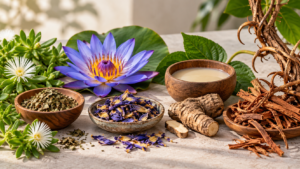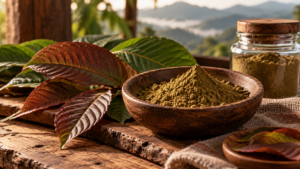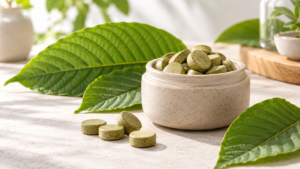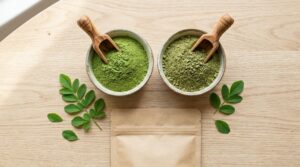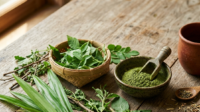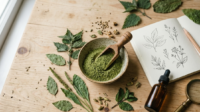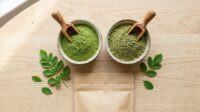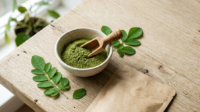
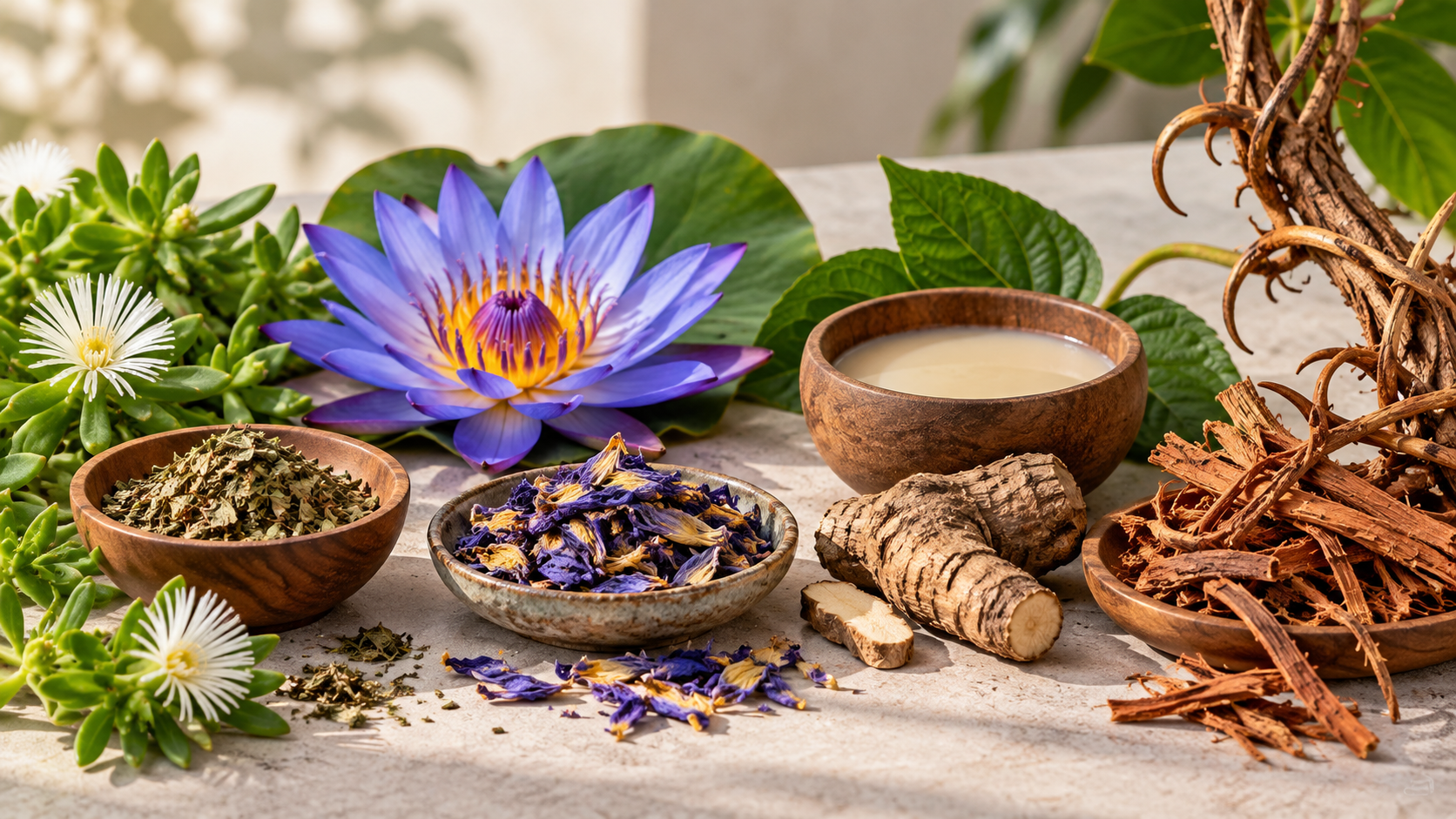
Kanna, blue lotus, kava, and cat’s claw are four unrelated plants from four different corners of the world, and each has its own history, chemistry, and set of cautions. None of them is a copy of kratom, and this guide will not pretend otherwise.
People end up searching this territory for many reasons. Some have read about kratom and want to understand what else sits on the botanical shelf. Some are curious about traditional plant preparations.
Some have run into confusing marketing that lumps very different plants together under a single vague heading. Whatever brought you here, the most useful thing a beginner can do is learn each plant on its own terms.
The Four Plants at a Glance
Here is the whole guide in one table. Each row summarizes a plant’s origin, traditional use, how strong the research is, and the main cautions. The sections below expand on every row.
| Plant | Origin | Traditional use | Research strength | Key cautions |
|---|---|---|---|---|
| Kanna (Sceletium tortuosum) | Southern Africa, especially South Africa’s arid Cape regions | Chewed or fermented by the Khoisan peoples, historically around hunger, thirst, and social or ceremonial occasions | Limited: a few small human trials on one standardized extract, plus lab studies | Possible interactions with antidepressants and other serotonergic medications; not studied in pregnancy |
| Blue lotus (Nymphaea caerulea) | Nile region and parts of East Africa; depicted in ancient Egyptian art | Steeped or soaked in wine or water in ancient Egypt; used in ritual and relaxation contexts | Very limited: mostly historical accounts and lab work, almost no clinical trials | Contains compounds that are also drugs; legal status varies; inconsistent products |
| Kava (Piper methysticum) | Pacific Islands, including Vanuatu, Fiji, Tonga, Samoa, and Hawaii | Root prepared as a water drink for ceremony, community, and hospitality | Moderate: several human trials on short-term use for anxiety, though results are mixed | Liver safety concerns, especially with alcohol, certain medications, and non-traditional extracts; can impair driving |
| Cat’s claw (Uncaria tomentosa) | Amazon rainforest and Central and South America | Bark decoctions for general wellness, joint comfort, and recovery | Modest: small trials for joint comfort and lab studies on immune signaling | May affect the immune system, blood pressure, and clotting; avoid in pregnancy and autoimmune conditions without medical guidance |
Notice how different the research strength column looks across rows. That column matters, because the confidence you can place in any claim about a plant depends far more on the evidence than on how long the plant has been around.
Kanna: The Succulent From Southern Africa
Kanna (Sceletium tortuosum) is a low-growing succulent native to the dry regions of southern Africa. It looks nothing like a typical herbal plant. Its fleshy, spreading stems resemble a small ground cover, and it belongs to the Aizoaceae family, sometimes called the ice plant family. That puts it far from kratom’s family, the Rubiaceae, in botanical terms.
Traditional use
The Khoisan peoples of what is now South Africa have used kanna for centuries. Accounts from early European travelers describe people chewing the plant, often after a fermentation process in which the crushed plant material was sealed and left to sit, then dried.
The preparation was known by names such as kougoed, meaning “something to chew.” It was associated with social gatherings, ceremony, and coping with long periods of hunger or thirst. Today kanna is sold in the modern market as a powder, capsule, tea, extract, and tincture.
What is inside
Kanna’s best-known compounds are the mesembrine-type alkaloids, including mesembrine, mesembrenone, and mesembrenol. Laboratory studies suggest these compounds may inhibit the reuptake of serotonin and may also inhibit an enzyme called PDE4.
In plain terms, that is a mechanism related to how some antidepressant medications work, which is why researchers have been curious about it. Alkaloid content varies widely depending on the plant, whether it was fermented, and how it was processed.
One point deserves to be stated clearly: kanna’s alkaloids are not opioids, and kanna does not act on opioid receptors.
How strong is the research?
The evidence is early. A small number of human studies have looked at a standardized kanna extract, most of them short and involving few participants. Some reported changes in measures of mood, stress, or cognition, but sample sizes are small, several studies were funded by the extract’s makers, and results have not been widely replicated.
Other research is laboratory-based and cannot tell us how kanna behaves in people. A fair summary is that kanna is interesting and under-researched, not proven.
Cautions
- Serotonergic interactions: Because of its proposed serotonin-related activity, kanna may interact with SSRIs, SNRIs, MAOIs, and other serotonergic drugs. Combining them could raise the risk of serotonin syndrome, a serious condition.
- Pregnancy and breastfeeding: There is no adequate safety data.
- Product variability: Traditional fermented material, unfermented material, and standardized extracts can differ substantially.
- Side effects: Reported effects in studies and consumer accounts include nausea, headache, and sleep changes.
Anyone using antidepressants or other psychiatric medication should speak with a prescriber before trying kanna.
Kanna vs Kratom: What Actually Separates Them
The kanna vs kratom question comes up because both are sold as powders and capsules, both have roots in traditional use, and both get discussed in similar online spaces. Beyond that, they diverge at nearly every level.
| Feature | Kanna | Kratom |
|---|---|---|
| Botanical name | Sceletium tortuosum | Mitragyna speciosa |
| Plant family | Aizoaceae (ice plant family) | Rubiaceae (coffee family) |
| Plant type | Low succulent | Tall evergreen tree |
| Native region | Southern Africa | Southeast Asia |
| Key compounds | Mesembrine-type alkaloids | Mitragynine, 7-hydroxymitragynine |
| Main proposed mechanism | Serotonin reuptake and PDE4 inhibition (lab evidence) | Partial agonism at mu-opioid receptors |
| Opioid receptor activity | No | Yes |
| Dependence concerns | Not established | Dependence and withdrawal reported |
| Regulatory picture in the U.S. | Generally sold as a supplement | Not approved by the FDA; banned in some states |
The difference that matters most
Kratom’s alkaloids act on opioid receptors. Kanna’s do not. That single distinction shapes the safety profile, the regulatory attention, and the kinds of risks each plant carries. Kratom’s concerns center on dependence, withdrawal, and its interaction with other sedating substances. Kanna’s main concerns center on interactions with serotonergic medications and the general lack of long-term data.
Is kanna a kratom alternative?
You will often see kanna described as a “kratom alternative.” That framing needs care. Someone hoping for kratom’s effects should not expect kanna to reproduce them, because the two plants work through different systems.
And anyone trying to reduce or stop kratom after regular use should not treat kanna, or any other botanical, as a withdrawal treatment. There is no evidence for that, and it could steer someone away from proper support. A doctor or addiction specialist is the right first call. In the U.S., the SAMHSA National Helpline at 1-800-662-4357 offers free, confidential referrals around the clock.
The honest way to see kanna is as its own botanical with its own story, not as a stand-in for anything else.
Blue Lotus: The Flower of the Nile
Blue lotus (Nymphaea caerulea), also called the blue water lily or Egyptian lotus, is an aquatic flowering plant with pale blue petals and a golden center. It is one of the most visually recognizable plants in ancient Egyptian culture, appearing in tomb paintings, carvings, and temple art. Its actual identity is worth flagging, because “blue lotus” is sometimes used loosely for other flowers, including the unrelated sacred lotus (Nelumbo nucifera).
Traditional use
Ancient Egyptian imagery shows the blue lotus in banquet scenes and associates it with rebirth and the sun. Some scholars believe the flowers were steeped in wine or water, though exactly how and why remains debated.
Because so much of blue lotus’s story comes from art and archaeology, historians often disagree about how literally to interpret the images. Modern products include dried flowers for tea, tinctures, extracts, and, less commonly, material sold for vaping.
What is inside
The compounds most often cited in blue lotus are apomorphine and nuciferine. Apomorphine is also a prescription drug used in certain medical settings, which is one reason regulators and clinicians look closely at blue lotus products. Nuciferine is an alkaloid also found in the sacred lotus. Reported amounts in dried flowers and products vary considerably, and the compounds can differ from one sample to the next.
How strong is the research?
Very limited. Most of what exists is historical interpretation and laboratory analysis. There are almost no well-designed human trials of blue lotus itself, so claims about specific effects rest largely on tradition and anecdote. If you see confident promises about what blue lotus will do, treat them skeptically.
Cautions
- Compounds with drug-like activity. Apomorphine and nuciferine act on the nervous system, and quantities in consumer products are rarely verified.
- Legal status varies. Blue lotus is restricted or regulated in some places, so check the rules where you live before buying.
- Inconsistent and mislabeled products. Because the plant is often confused with other flowers, look for the botanical name on labels and for third-party test results.
- Sedation and driving. Anything that may affect alertness deserves caution around driving or machinery.
- Pregnancy, breastfeeding, and medications. There is no reliable safety data.
For a beginner, blue lotus is best approached as a historically fascinating plant with thin modern evidence, rather than a well-characterized supplement.
Kava and the Kava Drink: A Pacific Tradition
Kava (Piper methysticum) is a shrub in the pepper family, native to the islands of the South Pacific. Communities in Vanuatu, Fiji, Tonga, Samoa, and Hawaii have cultivated it for generations, and it holds a central place in social and ceremonial life. Its roots, not its leaves, are the part used.
The traditional kava drink
The kava drink is the heart of the tradition. Dried or fresh root is ground or pounded, mixed with water, strained, and served, often in a shared bowl. In many Pacific communities it is prepared and served with formal etiquette, used to welcome guests, mark community events, and settle disputes. The drink is earthy and slightly bitter, and it can cause a numbing sensation on the lips and tongue.
Some details are worth knowing if you see kava in a modern setting:
- Water-based preparation is the traditional method. Modern supplements, by contrast, may use ethanol or acetone extracts, which differ chemically and are the ones most tied to safety concerns.
- Kava bars now operate across the United States, serving kava drink prepared from root powder or instant blends.
- Cultivar matters. Traditional “noble” varieties are the ones typically preferred for drinking, while others, sometimes called “tudei” or two-day varieties, are generally considered less suitable. Reputable vendors name the cultivar.
What is inside
Kava’s active compounds are called kavalactones. Researchers have identified around a dozen major kavalactones, and their profile differs among cultivars. They interact with several targets in the nervous system, including GABA-related pathways. Kavalactones are not opioids, and kava does not act on opioid receptors.
How strong is the research?
Kava has one of the stronger evidence bases in this guide, though “stronger” is relative. Several randomized trials have examined kava extracts for short-term anxiety, and systematic reviews have found some benefit over placebo in the near term. Results are not uniform, studies vary in preparation and dose, and long-term data are limited. Kava is not approved as a treatment for any condition.
Cat’s Claw: The Kratom Plant-Family Relative
Of the four plants here, cat’s claw is the only one that shares a plant family with kratom. Both belong to the Rubiaceae, the coffee family, and both contain indole alkaloids. That botanical kinship is real, and it is the reason the two are sometimes mentioned together. But cat’s claw is a very different plant with a very different profile, and it does not act on opioid receptors. It is not kratom-like in any meaningful sense.
Origin and traditional use
Cat’s claw is a woody climbing vine native to the Amazon rainforest and other tropical parts of Central and South America. It gets its name from the small curved thorns that resemble a cat’s claws. The two species most often sold are Uncaria tomentosa and Uncaria guianensis. Indigenous communities in Peru, including the Asháninka, have long used the inner bark and root bark, typically as a decoction, for general wellness, joint comfort, digestion, and recovery.
What is inside
Cat’s claw’s signature compounds are oxindole alkaloids, a subgroup of the indole alkaloids. Researchers distinguish between pentacyclic types, which are the focus of most immune-related research, and tetracyclic types, which appear to behave differently. The plant also contains polyphenols and other compounds. Good products name the species, the plant part, and ideally the amount of marker alkaloids.
Frequently Asked Questions
What is the main difference in kanna vs kratom?
They come from different plant families and work through different systems. Kratom’s alkaloids act on opioid receptors, while kanna’s mesembrine-type alkaloids do not. Kanna’s proposed activity relates to serotonin reuptake and PDE4, based mostly on laboratory evidence.
Is cat’s claw related to kratom?
Yes, botanically. Both belong to the Rubiaceae (coffee) family and produce indole alkaloids. But cat’s claw does not act on opioid receptors, and it is traditionally used for immune and joint support, not for kratom-like effects.
Is the kava drink safe?
Traditional water-based kava has a long history of ceremonial use, but the liver safety question is still debated, particularly for concentrated extracts and for people who drink alcohol or take liver-affecting medications. Anyone with liver concerns should speak with a clinician first.
Is blue lotus well studied?
No. Research is very limited, and most claims rest on historical accounts and lab analysis rather than human trials.
Which of these is an adaptogen?
We do not use that label for any of them. The term is loosely defined, and the evidence for these plants does not support the claim.
Can any of these replace kratom?
No. None of these plants reproduces kratom, and none is a treatment for kratom dependence or withdrawal. Anyone struggling to cut back should talk to a healthcare provider.
Final Thoughts
Kanna, blue lotus, kava, and cat’s claw are four separate stories. Kanna is a South African succulent with intriguing but early research. Blue lotus is a storied Nile flower with thin modern evidence. Kava is a Pacific ceremonial root with a moderate research base and real liver questions. Cat’s claw is an Amazonian vine, kin to kratom on the plant family tree, traditionally used for immune and joint support and studied modestly.
The pattern to take away is simple. Learn each plant on its own terms, weigh the strength of the evidence honestly, respect the cautions, and demand transparent testing from anyone selling it. A botanical does not need to be something else to be worth understanding.
More Resources
Working out with Kratom: Is it worth it?
What is 7-Hydroxymitragynine? A Complete Guide